As an Improvisational Style Game Master, I have a difficult time doing prep work. I find it very rewarding, especially when running a game with heavy elements of mystery and intrigue, but it is not always easy to do. A lot of prep work gets wasted when players do not go the direction you expect them to go, and that hurts a lot when you put all that effort doing something you do not enjoy just to make the game you run better. But can you really blame the players for pursuing something that they find more interesting in your game?
That’s not a rhetorical question. Are we allowed to do that? I’d love to know!
Back to point, I find that over the years I tend to compromise my prep work by spending most of my time prepping for improvisation. I prepare little fun encounters that can fit when a player does something random, or I stat up a crazy monster if I ever need to have one kick down a door to pick up the pace of a game.
Today I want to talk about making one of my favorite Improvisational Preparation tools, one of the simplest and most popular tools in our genre for embracing random encounters: the list!
Have you ever tried to run a mystery adventure in a game that was not specifically designed for mysteries and failed spectacularly? Everyone loves a good mystery, whether they see the end coming or are shocked by the big reveal. They appeal to one of our most basic linear instincts, if you believe anything you hear on Star Trek DS9.
That may be the most important thing to understand about humans. It is the unknown that defines our existence. We are constantly searching, not just for answers to our questions, but for new questions
Pulling off a good mystery in an RPG is not easy. There are so many things that can go wrong: the players miss a vital clue, the GM force-feeds information, an important detail is left out early on, a red herring takes us down a deep rabbit hole, or a TPK results in us never getting the answers we want.
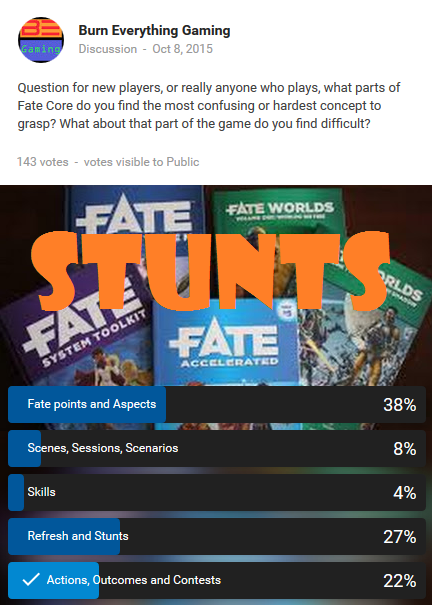
We asked some Fate players things they found confusing about Fate and below are the results.
Aspects and fate points can be challenging to understand, but with some patience and an understanding group you can usually get past the challenges with some easy rulings. Something like “I see what you want to do, but it doesn’t really make sense for the story right now,” can simply bypass a confusing situation all together.
Stunts, on the other hand, can’t really be bypassed. Once they are created, they are there. Once a player takes it and pays for it, it is a real part of the game. If it is too powerful, a GM cannot bypass it so easily. If a player doesn’t know how to use it, it becomes a waste of their refresh. And since stunts are persistent, any problems they cause will not go away after just one session.
Probably the MOST confusing thing about stunts is the open-ended invitation Fate Core makes to design your own with a pirate’s code analogy of guidelines. How can players and GMs judge what stunts abilities will fall in that sweet spot of “limited enough in scope to feel special when you use them, but not so narrow that you never see them come up?” Especially with a game like Fate Core where everyone works together to driver the story.
We’ve touched a bit on making stunts before, and we probably will again soon. But for now let’s take a look at 3 rules when dealing with stunts, three things that you must never EVER do.
We recently asked some people who enjoy Fate Core what parts they found confusing or complicated. We have already covered the most selected response, Aspects and Fate Points here, and here. We plan to also look at Refresh and Stunts in the near future, but right now we wanted to cover a more general area of just complications in general and how they were dealt with.
I guess we are doing a whole series of things on this poll.
So today we are going to look at some examples of Fate Core situations that got very complicated. It gives me a chance to walk down memory lane, and more importantly it gives us the chance to look at how the rules handle some of the crazy madness that comes from actually playing the games.
While we work on our next subject of Stunt Myths, related to this poll, we thought we would add something else about simplifying Fate points and Aspects.
Fate Core is a simple streamline system, but that does NOT mean it is always easy to play. The folks at Evil Hat designed it to handle everything, and sometimes figuring out how to cover that within the rules can give you quite the headache. No matter how much I think I know about the rules, there’s always something new to learn or something I assumed to be true that is not.
The trick with understanding how Fate works is to approach it like you would math (ugh) or maybe building with Legos (yay). You have to understand the very basics, and then put those basics together in order to make a complicated structure that looks like what you want. Things go wrong when you miss one of the basic elements, and it affects the large structure as a whole.
So today we are going to take another look at the rules of Fate Core and see how we can keep things simple.
I do not enjoy killing player characters. I have a lot of NPCs get killed, as you probably know if you listen to the podcasts. Player Character deaths are a lot trickier to manage. They are easy to do, sure. But they are very hard to make meaningful and even harder to get the players to celebrate.
In my experience, the only way to kill a PC and not lose a player over it is to make sure no one thinks it is your fault the PC died. Get them to believe that the game just worked out that way, that the dice roll was bad, or that someone in the group made a bad choice that led to their death. Of course, as the GM you really are the one that set them up to die, but so long as they don’t know it you can get away with it.
Here are a few tricks I’ve used over the years to get away with PC Murder. They do not all work for every occasion, but hopefully you can find something that will work for your campaign or at least inspire you to think.







 Burn Everything Gaming